If you run a small business in the UK and you’re VAT registered, you’ve probably heard the phrase “Making Tax Digital” thrown around by your accountant, in HMRC letters, or in adverts for software you’ve never heard of. Most explanations either skim the surface or bury you in legislation. Here’s what it actually means for your day-to-day bookkeeping, and what you need to have in place.
## What Making Tax Digital for VAT actually is
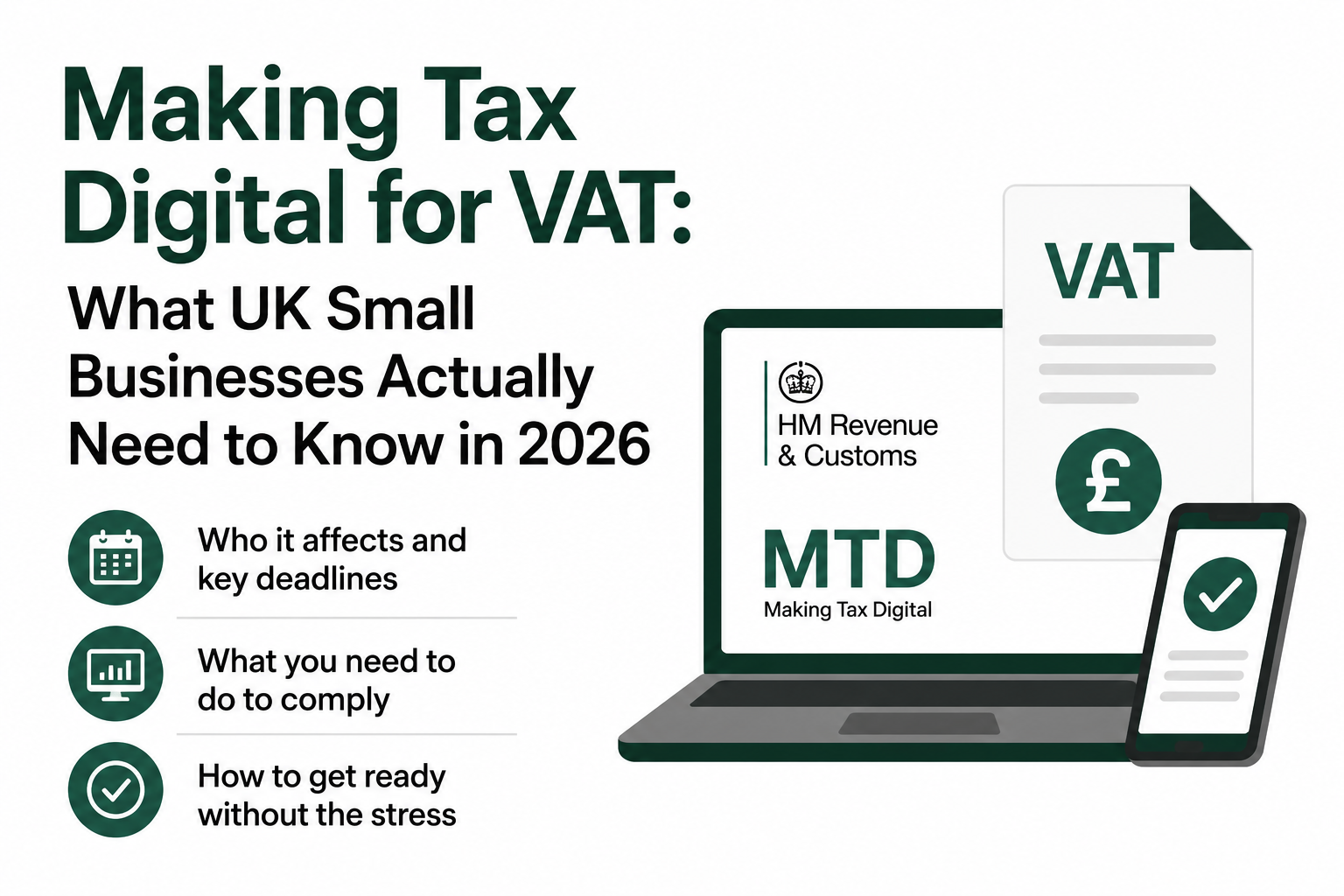
Making Tax Digital, or MTD, is HMRC’s requirement for VAT-registered businesses to keep digital records and submit VAT returns using compatible software, rather than typing figures into HMRC’s old online portal by hand. It’s been mandatory for the vast majority of VAT-registered businesses since April 2022, regardless of turnover.
In practice, that means two things:
1. Your VAT records need to be kept digitally — spreadsheets can sometimes qualify if they’re linked properly, but a shoebox of paper receipts and a calculator no longer meets the requirement on its own.
2. Your VAT return has to be submitted through software that connects to HMRC’s systems, not typed manually into a web form.
The intention behind it isn’t just admin for admin’s sake. HMRC’s reasoning is that digital records reduce the kind of small errors that come from manual re-entry — a transposed number here, a missed decimal point there — which is genuinely the most common reason small business VAT returns get flagged for review.
## Who this actually applies to
If you’re VAT registered at all, MTD applies to you. There’s no small business exemption anymore. That includes sole traders, partnerships, and limited companies. The only businesses with any flexibility are those with genuine, HMRC-approved exemptions — usually on religious or accessibility grounds, or where digital record-keeping simply isn’t practical (some remote or off-grid businesses, for example). These exemptions are narrow and have to be applied for; you can’t opt out just because you’d rather not deal with software.
## What “digital records” actually means in practice
This is where a lot of the confusion comes from, because HMRC’s requirements are less strict than most people assume, but also less flexible than they hope.
You need to digitally record:
– Your business name, address, and VAT registration number
– The VAT accounting scheme you use
– For each sale and purchase: the time of supply, the value, and the VAT rate charged
What you don’t need is a fully automated system that magically knows everything. You can absolutely use a spreadsheet, as long as the individual transaction data is there and it’s linked to your VAT return submission through what HMRC calls “digital links” — meaning the numbers flow through electronically, not by you retyping totals from one place into another. That retyping step is specifically what MTD is designed to eliminate, so it’s the one shortcut that genuinely isn’t allowed.
## Where most small businesses actually struggle
In practice, it’s rarely the VAT calculation itself that trips people up. It’s the record-keeping underneath it. A few patterns come up again and again:
**Receipts that never make it into the system.** A fuel receipt sits in a glovebox for six weeks. A supplier invoice gets buried in an email inbox. By the time your accountant asks for it, it’s genuinely hard to remember what it was for.
**Bank transactions that don’t match anything.** A payment goes out, but nobody’s noted what it was, so it either gets miscategorised or sits in limbo until someone chases it up.
**Spreadsheets that work fine until they don’t.** They’re fine for a few months, then a formula breaks, or two people are editing different versions, and suddenly nobody’s sure which one is correct.
None of these are really “MTD problems” — they’re bookkeeping problems that MTD has simply made visible, because sloppy records that used to slide through a manual system now show up as errors in a digital one.
## What actually helps
The businesses that find MTD painless, rather than a quarterly panic, tend to do a handful of things consistently:
– They capture receipts and invoices as soon as they get them, rather than stockpiling them for a big sort-out later
– They reconcile bank transactions regularly, not just at VAT deadline time
– They keep one single source of truth for their bookkeeping, rather than juggling a spreadsheet, a shoebox, and half-remembered bank statements
– They separate business and personal spending properly, even as a sole trader, so nothing needs untangling later
This is really just good bookkeeping hygiene — MTD hasn’t changed what good record-keeping looks like, it’s just made the cost of skipping it more immediate.
## Where AccoDrop fits in
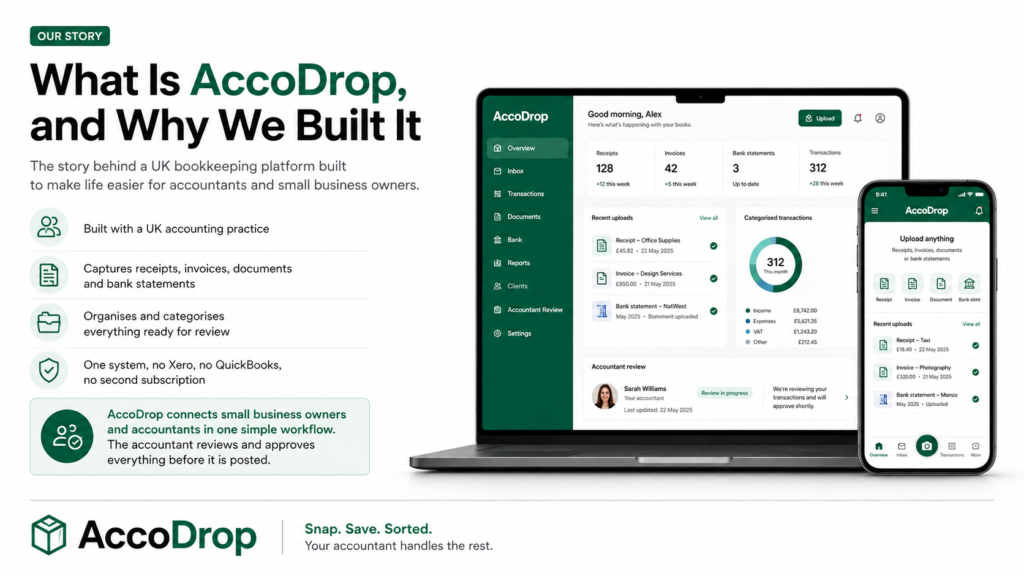
AccoDrop keeps your receipts, invoices, and bank statements organised in one place, so the record-keeping side of VAT — the part that actually causes most of the stress — doesn’t fall apart between quarters. Transactions get organised and prepared ready for your accountant to review, and your VAT records stay visible and up to date rather than scattered across email threads and paper piles.
To be clear about where things currently stand: direct MTD VAT submission to HMRC is something we’re actively developing and testing, but it isn’t live yet. What AccoDrop does today is make sure the records underneath your VAT return are properly organised and ready to hand to your accountant, so submission — whichever software handles that final step — is a formality rather than a scramble.
If you’re spending more time each quarter hunting for missing documents than actually reviewing your numbers, that’s usually a sign the record-keeping system needs fixing, not the VAT process itself.
—
*Have a question about keeping your bookkeeping MTD-ready? [Get in touch](/contact) — we’re happy to talk through what would actually help your business, not just what we’d like to sell you.*