If you drive for work — visiting clients, picking up stock, ferrying passengers, travelling between jobs — mileage is often one of the biggest expenses a sole trader can claim, and one of the most commonly got wrong. The maths itself is simple. The record-keeping underneath it is where most people either underclaim out of caution or lose the claim entirely because they can’t back it up.
## The current mileage rates
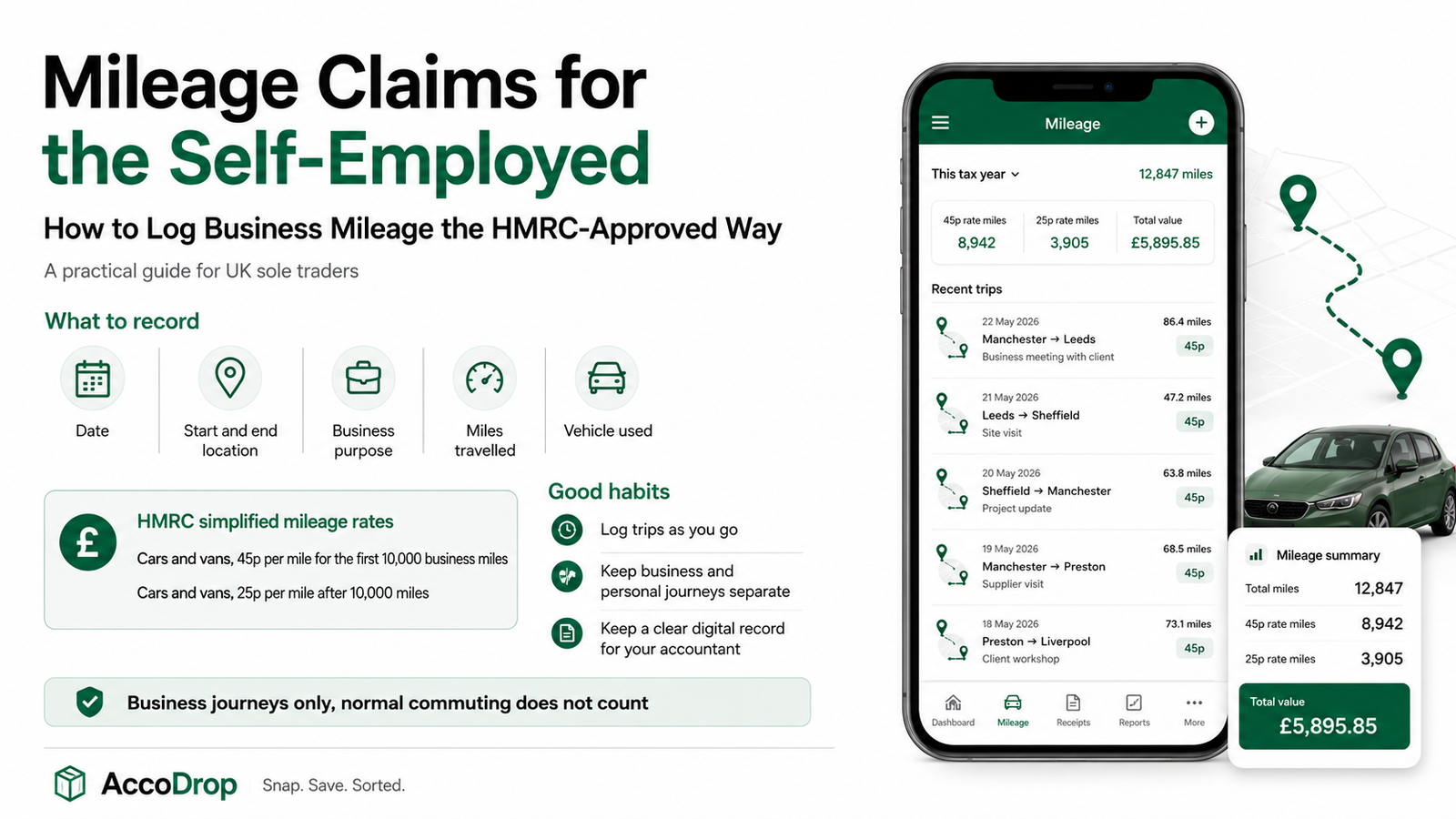
HMRC increased its mileage rate for the first time in over a decade. For the 2026/27 tax year, the approved rates are:
– **Cars and vans:** 55p per mile for the first 10,000 business miles in the tax year, then 25p per mile after that
– **Motorcycles:** 24p per mile, no threshold
– **Bicycles:** 20p per mile, no threshold
That 10,000-mile threshold resets each tax year, not each calendar year, and it’s a cumulative total across all your business driving, not per client or per vehicle. If you drove 12,000 business miles this year, the first 10,000 are claimed at 55p and the remaining 2,000 at 25p — not the full amount at either rate.
These rates already bake in fuel, insurance, servicing, tyres, road tax, and general wear and tear. That’s the part people most often get wrong.
## The mistake that gets whole claims disallowed
If you’re using the mileage rate method, you can’t also claim fuel receipts, servicing costs, or insurance separately for that vehicle. The 55p (or 25p) already accounts for all of it. Claiming both is easily the most common mileage error, and it’s not a small technicality — if HMRC reviews your records and finds fuel receipts alongside a mileage claim for the same vehicle, they can disallow the whole claim, not just the duplicated portion.
The alternative is claiming actual vehicle costs instead of mileage — a share of your real fuel, insurance, repairs, and depreciation, apportioned between business and personal use. This can work out better for some people, particularly those with an expensive or heavily used vehicle, but it requires much more detailed record-keeping and you generally have to stick with whichever method you choose for that vehicle going forward. Most sole traders find the mileage rate simpler to manage day to day.
## What actually counts as business mileage
This is the second biggest source of rejected claims. Business mileage is travel that isn’t your ordinary commute and isn’t personal.
**Counts:**
– Travelling to a client’s premises or a job site
– Trips between two different workplaces in the same day
– Travelling to a temporary workplace, even if it’s somewhere you visit regularly for a limited period
– Picking up supplies, stock, or equipment for the business
**Doesn’t count:**
– Your regular commute between home and your normal place of work
– Personal errands, even if you do them on the way to or from a work trip
– Travel that’s mostly personal with a small amount of incidental business purpose
The commute rule catches people out constantly, especially tradespeople and taxi drivers who feel like they’re “always working” the moment they leave the house. If you have a fixed base you travel to and from regularly, that journey is a commute, not business mileage, regardless of what you do once you arrive.
## What records you actually need to keep
A mileage claim without supporting records is a claim that’s hard to defend if HMRC ever asks. At minimum, for each business journey, you need:
– The date of the journey
– The start and end points
– The purpose of the trip
– The number of miles driven
A single spreadsheet updated the night before your tax return is technically possible, but it’s also exactly the kind of record that falls apart under scrutiny — vague destinations, guessed distances, and journeys that are hard to justify months after the fact. The businesses that don’t stress about this log the trip the same day, while the details are still fresh and the odometer reading is accurate.
## Passengers and electric vehicles
If you carry another person on a qualifying business journey — a colleague, an employee, someone directly connected to that piece of work — you can claim an additional 5p per mile per passenger, on top of the standard rate. This has to be tracked separately per passenger per trip; it’s not an automatic addition.
Electric and hybrid vehicles follow exactly the same rate structure as petrol and diesel cars — there’s no separate reduced rate for EVs under the current mileage scheme, despite what a lot of outdated guidance online still suggests.
## One vehicle, one method
If you have more than one vehicle used for business, each one is treated separately, and you can’t mix the mileage rate for one vehicle with actual-cost claims for another in a way that lets you cherry-pick whichever is more generous. Once you’ve chosen a method for a given vehicle, HMRC expects consistency for that vehicle going forward, not a method chosen fresh each tax year based on which worked out better last time.
## Keeping this from becoming a headache
Mileage claims are one of those things that are genuinely simple in principle and genuinely painful in practice, purely because of timing. Log it as you go, and it’s a two-minute habit. Try to reconstruct six months of journeys from memory in January, and it becomes a stressful guessing exercise that either underclaims out of caution or gets flagged for being vague.
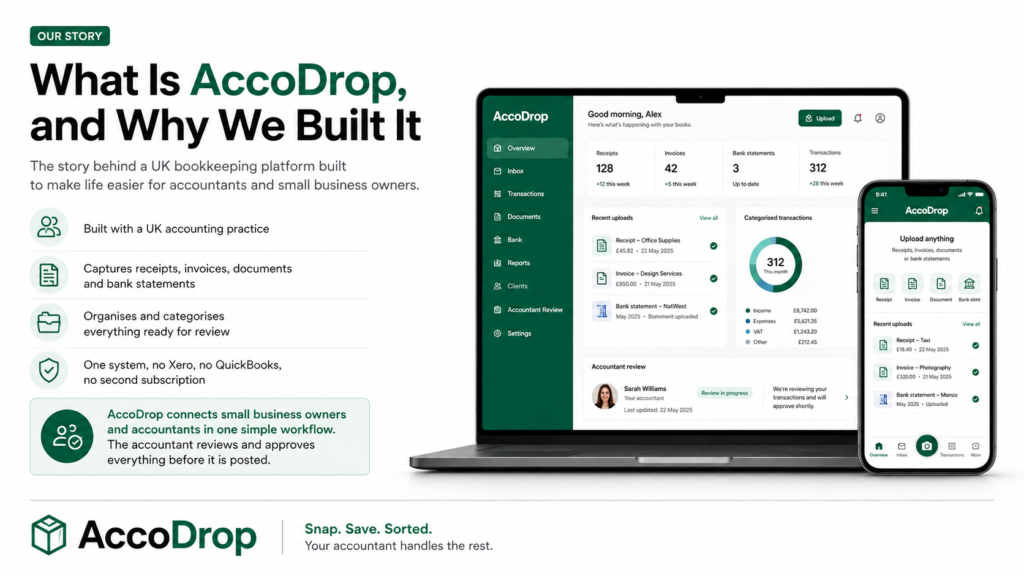
AccoDrop includes mileage logging built around the current HMRC rates, so trips get recorded properly as they happen rather than reconstructed later. It’s designed to sit alongside your other records — receipts, invoices, bank statements — so your accountant sees a complete, organised picture rather than mileage sitting apart from everything else as an afterthought.
If you’re not sure whether the mileage rate or actual costs method suits your situation better, that’s worth a specific conversation with your accountant — it depends on your vehicle, how much you drive, and how the numbers actually work out for you, not a one-size-fits-all answer.
—
*Want your mileage records organised alongside the rest of your bookkeeping, without the year-end scramble? [Get in touch](/contact) — we’re happy to show you how it works.*